The erasure of a single bit of information has a thermodynamic cost. Landauer's principle, formulated in 1961, fixes the minimum heat that must be dissipated into the environment when a logically irreversible operation like erasure is performed. Its validity has been verified in a multitude of microscopic experiments over the past decade. The bound, however, holds strictly only for memories that are in thermal equilibrium at the start of the operation. Real-world memories spend most of their time far from equilibrium, and whether the same energetic floor applies to those memories has remained an open question. Here we analyze experimentally the erasure of a bit stored in a nonequilibrium state of an optomechanical two-state memory. We show that the nonequilibrium character of a memory state enables full erasure with reduced power consumption as well as negative heat production.
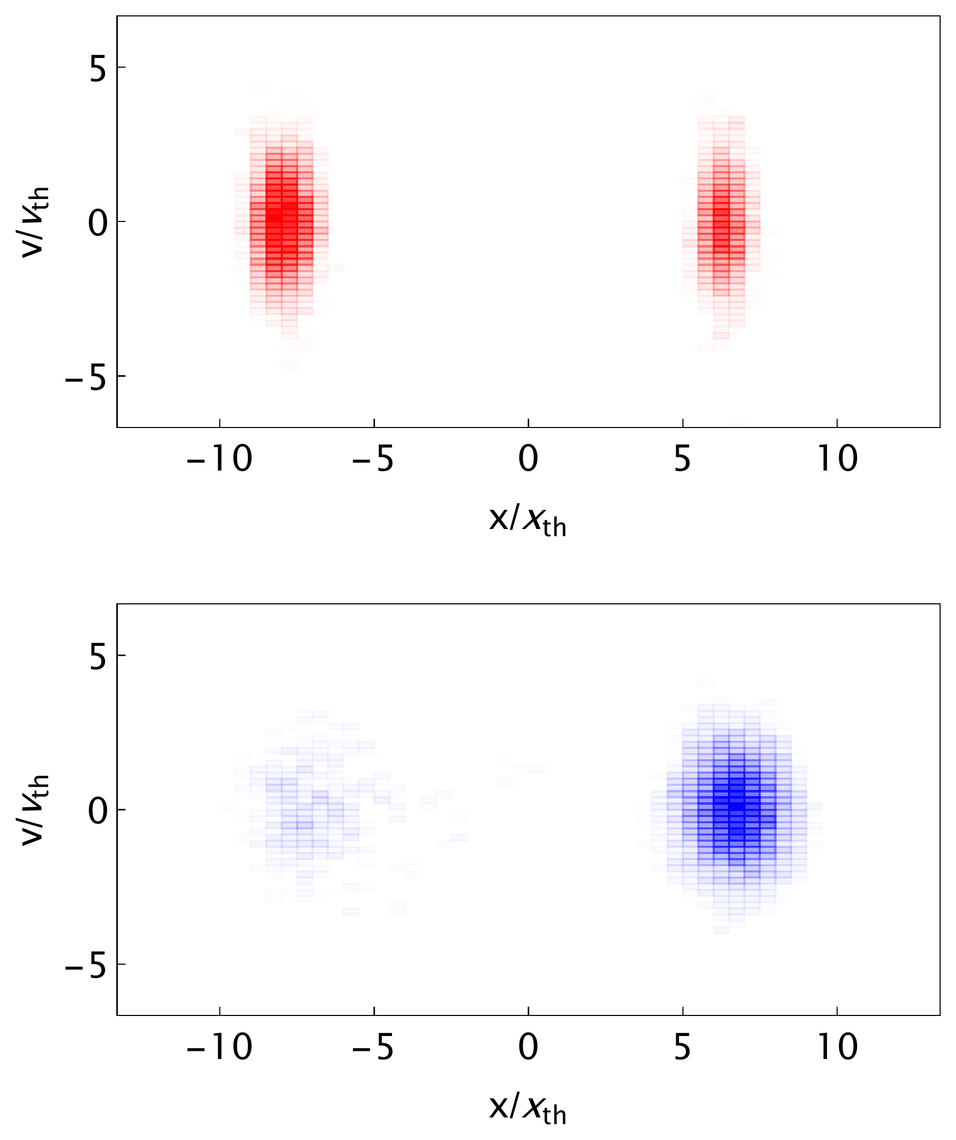
We implement a one-bit memory using a charged silica nanoparticle (radius ≈ 74 nm) trapped in a double-well optical potential, encoding bit values “0” and “1” in the two wells. The double-well is synthesised from two orthogonally polarised laser beams, a TEM00 and a TEM10 mode, whose relative power controls the barrier height and well shape in real time. A pair of electrodes mounted near the trap applies a time-varying tilt on the charged particle. Information is erased by resetting the memory to state “0” irrespective of the initial state. We implement this reset-to-zero by modulating the shape of the potential by varying the laser power, decreasing the barrier height and applying a tilt to the left. In addition, the memory is initialized in an out-of-equilibrium state by briefly exposing the particle to a steeper preparation potential, which compresses the intra-well position distribution and reduces its entropy below the equilibrium value. The full erasure protocol is then performed within 1.3 ms — five orders of magnitude faster than equivalent overdamped colloidal experiments. We infer the averaged consumed work and dissipated heat for various nonequilibrium scenarios and observe that the nonequilibrium quantities are smaller than the corresponding equilibrium values. The dissipated heat can even become negative, indicating that the environment absorbs net heat during the erasure.
Our work establishes levitated optomechanics as a testbed for far-from-equilibrium thermodynamics of information, beyond the equilibrium regime in which Landauer's principle was formulated. The dynamical potential-shaping technique we develop for the erasure protocol is a general tool for future levitated-nanoparticle experiments that call for arbitrary, time-dependent force landscapes.
Publication:
Erasure of a nonequilibrium memory beyond Landauer's bound using levitated optomechanics with spatio-temporal optical control
M. A. Ciampini, T. Wenzl, M. Konopik, G. Thalhammer-Thurner, M. Aspelmeyer, E. Lutz, and N. Kiesel
Phys. Rev. Research 7, 043321 (2025) - archiv-Version