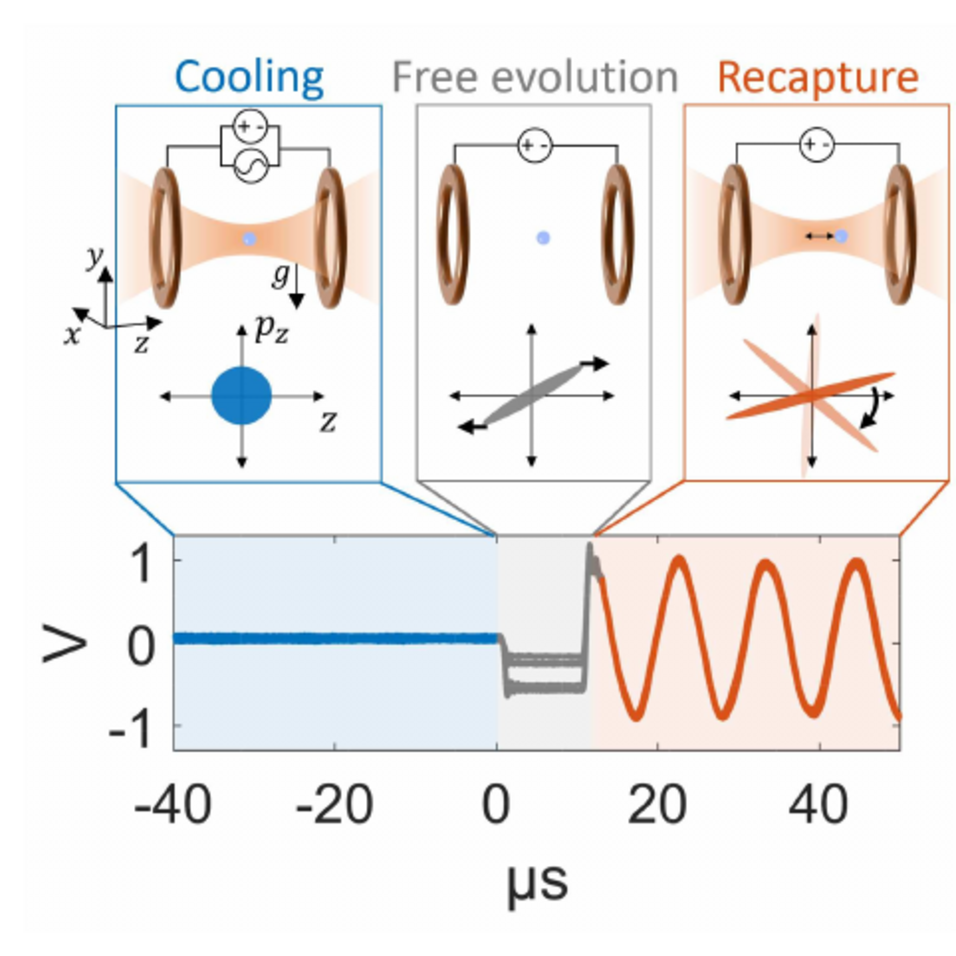
Expanding the center-of-mass quantum state of a massive particle is an integral part of many experimental protocols that aim to explore macroscopic quantum phenomena. While free state evolution in the absence of a harmonic trapping potential is an effective expansion scheme, even small forces result in significant displacements that can be detrimental for successive measurements on the particle wavepacket. Using an optical trap-release-recapture sequence, we demonstrate an electrostatic compensation technique that enables free evolution without significant mean displacement in 3D for 156 nm diameter silica particles. Our approach achieves static force compensation at the 2 × 10⁻¹⁸ N level, effectively freezing the particle position during 100 µs of free evolution while the trap is turned off.
The two dominant residual forces on the particle — gravity and stray electric fields from charged surfaces in the environment — are cancelled in three spatial directions using electrostatic counter-fields applied via a set of nearby electrodes. Reaching the quoted compensation level required mapping and correcting the force cross-talk between the compensation electrodes. For short free evolution times (5 µs) with 3D compensation we also find that the state recompresses to its initial extent, implying no significant loss of purity.
We anticipate that the methods we have developed to enable long, coherent free evolutions of charged nanoparticles will provide an essential tool for the further extension of levitated experiments into the quantum regime.
Publication:
Free expansion of a charged nanoparticle via electrostatic compensation
D. Steiner, Y. Y. Fein, G. Meier, S. Lindner, P. Juschitz, M. A Ciampini, M. Aspelmeyer, N. Kiesel
Appl.Phys.Lett.127, 191103 (2025) - arXiv-Version